

-
2381
-
1744
-
1573
-
1319
-
1179
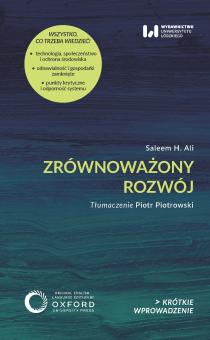
Zrównoważony rozwój
Rosnące obawy dotyczące globalnych zmian środowiskowych i wpływu człowieka na planetę doprowadziły do powstania szerokiej dziedziny badań nad zrównoważonym rozwojem. To propozycja korzystna dla obu stron – człowieka i środowiska.
Prezentowana publikacja stanowi spójną syntezę tego złożonego zagadnienia, wydobywa kluczowe wątki: rozwój technologii, punkty krytyczne oraz odporność systemów naturalnych i społecznych, odnawialność, a także wpływ polityki na zmiany antropogeniczne.
Allwood, J. M., et al. (2017). Industry 1.61803: The Transition to an Industry with Reduced Material Demand Fit for a Low Carbon Future. Philosophical Transactions of the Royal Society A: Mathematical, Physical and Engineering Sciences, 375(2095), 20160361. https://doi.org/10.1098/rsta.2016.0361
Armstrong McKay, D. I., et al. (2022). Exceeding 1.5 C Global Warming Could Trigger Multiple Climate Tipping Points. Science, 377(6611), eabn7950. https://doi.org/10.1126/science.abn7950
Ayres, R. U. (2008). Sustainability Economics: Where Do We Stand? Ecological Economics, 67(2), s. 281–310. https://doi.org/10.1016/j.ecolecon.2007.12.009
Caradonna, J. L. (2016). Sustainability: A History. Reprint edition. Oxford: Oxford University Press.
Cardoso, R., Sobhani, A., Meijers, E.(2022). The Cities We Need: Towards an Urbanism Guided by Human Needs Satisfaction. Urban Studies, 59(13), s. 2638–2659. https://doi.org/10.1177/00420980211045571
Chertow, M. R. (2000). The IPAT Equation and Its Variants. Journal of Industrial Ecology, 4(4), s. 13–29. https://doi.org/10.1162/10881980052541927
Clark, W. C., Dickson, N. M. (2003). Sustainability Science: The Emerging Research Program. Proceedings of the National Academy of Sciences, 100(14), s. 8059–8061.
Clark, W. C., Harley, A. G. (2020). Sustainability Science: Toward a Synthesis. Annual Review of Environment and Resources, 45(1), s. 331–386. https://doi.org/10.1146/annurev-environ-012420-043621
Costanza, R., Fisher, B., Ali, S., Beer, C., Bond, L., Boumans, R., Danigelis, N. L., Dickinson, J., Elliott, C., Farley, J., Gayer, D. E., Glenn, L. M., Hudspeth, T., Mahoney, D., McCahill, L., McIntosh, B., Reed, B., Rizvi, S. A. T., Rizzo, D. M., … Snapp, R. (2007). Quality of Life: An Approach Integrating Opportunities, Human Needs, and Subjective Well-Being. Ecological Economics, 61(2), s. 267–276. https://doi.org/10.1016/j.ecolecon.2006.02.023
Dasgupta, P. (2001). Human Well-Being and the Natural Environment. Oxford: Oxford University Press.
DiNapoli, R. J., Lipo, C. P., Hunt, T. L. (2021). Triumph of the commons: Sustainable community practices on Rapa Nui (Easter Island). Sustainability, 13(21), 12118. https://doi.org/10.3390/su132112118
Ehrenfeld, J. (2009). Sustainability by Design. New Haven: Yale University Press.
Esty, D. C., ed. (2019). A Better Planet: Forty Big Ideas for a Sustainable Future. New Haven: Yale University Press.
Fanning, A. L., et al. (2022). The Social Shortfall and Ecological Overshoot of Nations. Nature Sustainability, 5(1), s. 26–36. https://doi.org/10.1038/s41893-021-00799-z
Farmer, J. D., Hepburn, C., Ives, M. C., Hale, T., Wetzer, T., Mealy, P., Rafaty, R., Srivastav, S., Way, R. (2019). Sensitive Intervention Points in the Post-Carbon Transition. Science, 364(6436), s. 132–134. https://doi.org/10.1126/science.aaw7287
Florin, M.-V., et al., International Risk Governance Center at EPFL (IRGC), eds. (2023). Ensuring the Environmental Sustainability of Emerging Technologies. Lausanne: EPFL. https://doi.org/10.5075/epfl-irgc-298445
Franzke, C. L. E., et al. (2022). Perspectives on Tipping Points in Integrated Models of the Natural and Human Earth System: Cascading Effects and telecoupling. Environmental Research Letters, 17(1), 015004. https://doi.org/10.1088/1748-9326/ac42fd
Friedman, B. M. (2006). The Moral Consequences of Economic Growth. New York: Vintage.
Gatti, L. V., Basso, L. S., Miller, J. B., Gloor, M., Gatti Domingues, L., Cassol, H. L. G., Tejada, G., Aragão, L. E. O. C., Nobre, C., Peters, W., Marani, L., Arai, E., Sanches, A. H., Corrêa, S. M., Anderson, L., Von Randow, C., Correia, C. S. C., Crispim, S. P., Neves, R. A. L. (2021). Amazonia as a Carbon Source Linked to Deforestation and Climate Change. Nature, 595(7867), Article 7867. https://doi.org/10.1038/s41586-021-03629-6
George, D. A. R., Lin, B. C., Chen, Y. (2015). A Circular Economy Model of Economic Growth. Environmental Modelling & Software, 73, s. 60–63. https://doi.org/10.1016/j.envsoft.2015.06.014
Gibson, R., et al. (2009). Sustainability Assessment: Criteria and Processes. London: Earthscan.
Hamann, M., Biggs, R., Reyers, B. (2015). ‘Mapping Social-Ecological Systems: Identifying „Green-Loop” and „Reed-Loop” Dynamics Based on Characteristic Bundles of Ecosystem Service Use. Global Environmental Change, 34, s. 218–26. https://doi.org/10.1016/j.gloenvcha.2015.07.008
Hickel, J. et al. (2022). Imperialist Appropriation in the World Economy: Drain from the Global South Through Unequal Exchange, 1990–2015. Global Environmental Change, 73, s. 102467.
Hotelling, H. (1931). The Economics of Exhaustible Resources. Journal of Political Economy, 39(2), s. 137–175. https://doi.org/10.1086/254195
Kahneman, D., Krueger, A. B., Schkade, D., Schwarz, N., Stone, A. A. (2006). Would You Be Happier if You Were Richer? A Focusing Illusion. Science, 312(5782), s. 1908–1910.
Kaplinsky, R. (2021). Sustainable Futures: An Agenda for Action. Cambridge–Medford, MA: Polity.
Kates, R. W., et al. (2001). Sustainability Science. Science, 292 (5517), s. 641–642.
Kenny, M., Meadowcroft, J., eds. (1999). Planning Sustainability. London: Routledge.
Leach, M., et al. (2018). Equity and Sustainability in the Anthropocene: A Social-Ecological Systems Perspective on Their Intertwined Futures. Global Sustainability, 1, s. e13. https://doi.org/10.1017/sus.2018.12
Lemisch, J. (2001). Nader versus the Big Rock Candy Mountain. New Politics, 7(3), s. 12.
Lenton, T. M., Held, H., Kriegler, E., Hall, J. W., Lucht, W., Rahmstorf, S., Schellnhuber, H. J. (2008). Tipping Elements in the Earth’s Climate System. Proceedings of the National Academy of Sciences, 105(6), s. 1786–1793. https://doi.org/10.1073/pnas.0705414105
Markard, J., Geels, F. W., Raven, R. (2020). Challenges in the Acceleration of Sustainability Transitions. Environmental Research Letters, 15(8), s. 081001. https://doi.org/10.1088/1748-9326/ab9468
Mazzocchi, F. (2020). A Deeper Meaning of Sustainability: Insights from Indigenous Knowledge. The Anthropocene Review, 7(1), s. 77–93. https://doi.org/10.1177/2053019619898888
Miller, D. (2001). The Poverty of Morality. Journal of Consumer Culture, 1(2), s. 225–243.
Motesharrei, S., Rivas, J., Kalnay, E. (2014). Human and Nature Dynamics (HANDY): Modeling Inequality and Use of Resources in the Collapse or Sustainability of Societies. Ecological Economics, 101, s. 90–102. https://doi.org/10.1016/j.ecolecon.2014.02.014
Ortega y Gasset J. (2008). Medytacje o „Don Kichocie”. Warszawa: Wydawnictwo MUZA.
Otto, I. M., et al. (2020). Social Tipping Dynamics for Stabilizing Earth’s Climate by 2050. Proceedings of the National Academy of Sciences, 117(5), s. 2354–2365. https://doi.org/10.1073/pnas.1900577117
Princen, T. (2005). The Logic of Sufficiency. Cambridge, MA: MIT Press.
Rammelt, C. F., et al. (2022). Impacts of Meeting Minimum Access on Critical Earth Systems Amidst the Great Inequality. Nature Sustainability, 6, s. 1–10. https://doi.org/10.1038/s41893-022-00995-5
Rosen, M. A., Dincer, I., Kanoglu, M. (2008). Role of exergy in increasing efficiency and sustainability and reducing environmental impact. Energy Policy, 36(1), s. 128–137. https://doi.org/10.1016/j.enpol.2007.09.006
Sayre, N. F. (2008). The Genesis, History, and Limits of Carrying Capacity. Annals of the Association of American Geographers, 98(1), s. 120–34. https://doi.org/10.1080/00045600701734356.
Schelling, T. C. (1978). Micromotives and Macrobehavior. W.W. Norton and Company.
Schor, J. B. (1999). The Overspent American: Why We Want What We Don’t Need. New York: Harper Paperbacks.
Scown, C. D., Keasling, J. D. (2022). Sustainable Manufacturing with Synthetic Biology. Nature Biotechnology, 40(3), s. 304–307. https://doi.org/10.1038/s41587-022-01248-8
Shafik, N. (1994). Economic Development and Environmental Quality: An Econometric Analysis. Oxford Economic Papers, 46 (Supplement_1), s. 757–773. https://doi.org/10.1093/oep/46.Supplement_1.757
Steffen, W., et al. (2020). The Emergence and Evolution of Earth System Science. Nature Reviews Earth & Environment, 1(1), s. 54–63. https://doi.org/10.1038/s43017-019-0005-6
Swilling, M. (2019). The Age of Sustainability: Just Transitions in a Complex World. London: Routledge.
Taylor, G. (2008). Evolution’s Edge: The Coming Collapse and Transformation of Our World. Gabriola Island, BC: New Society Publishers.
Teicher, J. (2021). Donut Economics Has a Hole at Its Core. Jacobin, Sep. 24. https://jacobin.com/2021/09/doughnut-economics-raworth-amsterdam-capitalism-socialism
Twitchell, J. B. (2000). Lead Us into Temptation. New York: Columbia University Press.
Valero, A., Valero, A., Calvo, G., Ortego, A. (2018). Material bottlenecks in the future development of green technologies. Renewable and Sustainable Energy Reviews, 93, s. 178–200. https://doi.org/10.1016/j.rser.2018.05.041
Vries, B. J. M. de (2012). Sustainability Science. Cambridge: Cambridge University Press.
West, G. (2017). Scale: The Universal Laws of Growth, Innovation, Sustainability, and the Pace of Life in Organisms, Cities, Economies, and Companies. London: Penguin.
Wunderling, N., et al. (2022). Global Warming Overshoots Increase Risks of Climate Tipping Cascades in a Network Model. Nature Climate Change, 13, s. 1–8. https://doi.org/10.1038/s41558-022-01545-9
York, R., Rosa, E. A., Dietz, Th. (2003). STIRPAT, IPAT and ImPACT: Analytic Tools for Unpacking the Driving Forces of Environmental Impacts. Ecological Economics, 46(3), s. 51–65. https://doi.org/10.1016/S0921-8009(03)00188-5
Licencja

Utwór dostępny jest na licencji Creative Commons Uznanie autorstwa – Użycie niekomercyjne – Bez utworów zależnych 4.0 Międzynarodowe.
Jak cytować
Dyscypliny
- Archeologia
- Bibliologia i informatologia
- Biologia
- Chemia
- Ekonomia i zarządzanie
- Etnologia i antropologia kulturowa
- Filologia polska
- Filologie obce
- Filozofia
- Fizyka
- Geografia
- Historia
- Językoznawstwo
- Judaica
- Kultura i sztuka
- Literaturoznawstwo
- Matematyka
- Pedagogika
- Podręczniki dla cudzoziemców
- Politologia i stosunki międzynarodowe
- Prawo
- Psychologia
- Socjologia
- Varia
- Otwarty dostęp
Seria
- 100 lat niepodległości
- Akademia Samorządowa
- Akademia Zarządzania i Finansów
- Aktywni (nie)pełnosprawni
- Analecta Literackie i Językowe
- Bałkany XX/XXI
- Bibliotheca Litteraria
- Bibliotheca Philosophica
- Biografia i Badanie Biografii
- Byzantina Lodziensia
- Contemporary Asian Studies Series
- Cyfryzacja
- Edukacja dla Mądrości
- Ekonomia
- Filmo!znawcy
- Finanse
- Gerontologia
- Interdyscyplinarne Studia Miejskie
- Interpretacje Literackie
- Jerzy Giedroyc i…
- Jerzy Giedroyc i Świadkowie Historii
- Jesień Życia?
- Językoznawstwo
- Judaica Łódzkie
- Jurysprudencja
- Kim Jest Człowiek?
- Kognitywistyka
- Komunikacja i Media
- Krótkie Wprowadzenie
- Kultura Literacka Łodzi
- Literaturoznawstwo. Sylwetki
- Łódzkie Studia z Językoznawstwa Angielskiego i Ogólnego
- Łódź w PRL. PRL w Łodzi
- Manufactura Hispánica Lodziense
- Marketing
- Monografie Sekcji Socjologii Niepełnosprawności PTS
- Nauka Sztuki – Sztuka Nauki
- Oblicza feminizmu
- Oblicza wojny
- Perspektywy Biograficzne
- Politologia
- Polska a Europa Środkowo-Wschodnia w XX wieku
- Polska Kultura Filmowa
- Prawo
- PRL. Biografie
- Projekt: Egzystencja i Literatura
- Psychologia Wszystkiego
- Research on Science & Natural Philosophy
- Romanistyka dla Teatru
- Series Ceranea
- Stała Konferencja Pedagogiki Społecznej pod Patronatem Komitetu Nauk Pedagogicznych PAN
- Sztuka-Media-Kultura
- Terapia Pedagogiczna
- Twórczość i Edukacja
- Vade Nobiscum
- Warsztaty z Geografii Turyzmu
- W poszukiwaniu idei XXI wieku
- W Wieży Babel po polsku
- Zarządzanie
- Życie prywatne Polaków w XIX wieku