

-
5200
-
3410
-
3404
-
3248
-
2879
In the Mirror of Things
Jarosław Kita (ed.)
Uniwersytet Łódzki, Wydział Filozoficzno-Historyczny, Instytut Historii Katedra Historii Polski XIX wieku
https://orcid.org/0000-0002-8374-2848 (unauthenticated)
Maria Korybut-Marciniak (ed.)
Uniwersytet Warmińsko-Mazurski w Olsztynie, Wydział Humanistyczny, Instytut Historii, Zakład Europy Wschodniej
https://orcid.org/0000-0001-8196-5119 (unauthenticated)
Volume:
10
ISBN (e-book) Wydawnictwo Uniwersytetu Łódzkiego
ISBN-13 (15)
978-83-8220-764-4
ISBN Wydawnictwo Uniwersytetu Łódzkiego
ISBN-13 (15)
978-83-8220-763-7
ISBN Uniwersytet Warmińsko-Mazurski
ISBN-13 (15)
978-83-65171-51-1
Keywords:
Polish spas, sanitation, hygiene, livestock, wedding expedition, private life of Poles in the 19th century
Published:
30 December 2022
Categories:
History, Open Access
Downloads
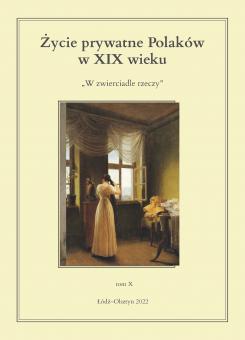
The next, tenth jubilee volume of the publishing series Private Life of Poles in the 19th Century, similarly to the previous volumes, was also born out of the need for a different story about the past. This time we propose a new cognitive perspective of the private life and everyday life of the epoch – its view – through the prism of people’s material surroundings. Privacy „in the Mirror of Things”, that is focusing attention on the material environment in which the life of Poles under the partitions passed, allowed for the introduction of individual private worlds, showing scenes and the rhythm of everyday life, cultural landscapes, living spaces that remained in the shadows. Objects surrounding a person can be analyzed through the prism of their usefulness, typology, genesis, and territorial scope. Traditional studies of material culture have often lost the social context of artifacts. It is worth looking at their role in a broader perspective. Seemingly silent objects, collected by life, surrounding a person, selected, protected, rejected, constitute a mirror that can speak with an appropriate set of questions. The world of things surrounding a person reflects the reality of his daily existence, his mentality, standard of living, professed values, aesthetic preferences, family ties, the nature of everyday activities, ways of spending free time, group membership, attitude to fashion, religion, and civilization changes.
The editors are aware that the presented volume is not exhaustive and only provokes further discourse on the private life of Poles in the 19th century. The prism of „things” opened up an additional spectrum of research possibilities in the sphere of everyday and intimate life of Polish society under the partitions. The articles did not reflect on the mentality of the people of the era to which the door was opened by material sources. The forms surrounding Poles in the nineteenth century made it possible to observe changes within culture, made it possible to penetrate into inaccessible social environments, and the presentation of biographies through „things” shed new light on the figures studied so far only through written sources. „The Mirror of Things” may become an inspiration for further studies on Polish society during the partitions.
„In the Mirror of Things” – Introduction
Jarosław Kita, Maria Korybut-Marciniak
Devices for balneotherapy in Polish spa in XIX century
Jarosław Kita
In a 19th century psychologist’s laboratory
Daria Domarańczyk-Cieślak
Beauty and Health. Criticism of cosmetics in the hygienic discourse of the second half of the 19th century
Anita Napierała
In ladies’ boudoir. Hygiene of women in the nineteenth century on examples from the collection of Museum of Warmia and Masuria in Olsztyn
Anna Malinowska
Material legacy of Stanisław Polakowski, a teacher from the turn of the 19th and 20th centuries
Dariusz Złotkowski
The world of things of a representative of the Warsaw intelligentsia in the inter-uprising period – the example of Julian Bartoszewicz
Ilona Florczak
Items from lodgings on Southampton Street. Posthumous inventory of Polish insurgent from 1830 as a reflection of the fate of emigrants
Krzysztof Marchlewicz
Voices trapped in herbaria. Forgotten female researchers of Lithuanian flora in the 19th century
Maria Korybut-Marciniak
…Exhaust all sources for this subject first – Jan Matejko
Marta Kłak-Ambrożkiewicz
(Un)usual gifts in the (un)usual everyday life of the Krasiński family
Aldona Łyszkowska
Secrets of the maiden rooms. Objects of desire of nineteenth-century teenagers based on handbook literature
Kinga Raińska
Wedding expedition, home and travel expenses of Józefa Potocka Ostrowska (1784–1859)
Alicja Adamus, Karolina Studnicka-Mariańczyk
Witnesses of the stay in the Citadel, companions of exile. About things around prisoners
Jolanta Załęczny
Sic transit gloria mundi – crypts of selected southern landscapes of the Southern Wielkopolska
Emilian Prałat
The Cemetery in Opinogóra. Traces of human resumes
Wojciech Jerzy Górczyk
Download data is not yet available.
Copyright (c) 2022 © Copyright by Authors, Łódź 2022; © Copyright for this edition by Uniwersytet Łódzki, Łódź 2022
License

This work is licensed under a Creative Commons Attribution-NonCommercial-NoDerivatives 4.0 International License.
Category
- Archaeology
- Bibliology and information science
- Biology
- Chemistry
- Economics and management
- Ethnology and cultural anthropology
- Polish philology
- Foreign language studies
- Philosophy
- Physics
- Geography
- History
- Linguistics
- Judaica
- Culture and art
- Literary Studies
- Mathematics
- Pedagogy
- Textbooks for foreigners
- Political science and international relations
- Law
- Psychology
- Sociology
- Other
- Open Access
Series
- 100 Years of Independence
- The Academy of Local Governments
- The Academy of Management and Finance
- Handicapable
- Literary and Linguistic Analects
- Balkans XX/XXI
- Bibliotheca Litteraria
- Bibliotheca Philosophica
- Biography and Biography Research
- Byzantina Lodziensia
- Contemporary Asian Studies Series
- Digitisation
- Education for Wisdom
- Economics
- Film! Scholars
- Finance
- Gerontology
- Interdisciplinary Urban Studies
- Literary Interpretations
- Jerzy Giedroyc and...
- Jerzy Giedroyc and Witnesses of History
- Winter of Life?
- Linguistics
- Judaica Lodzensia
- Jurisprudence
- What Is Man?
- Cognitive Science
- Communication and Media
- A Very Short Introduction
- Literary Culture of Lodz
- Literary Studies
- Lodz Studies in English and General Linguistics
- Lodz in the Polish People's Republic. The Polish People's Republic in Lodz
- Manufactura Hispánica Lodziense
- Marketing
- The monographs of the Section of Disability Sociology of the Polish Sociological Association
- The Art of Learning – The Learning of Art
- Neuroscience in Psychology
- Faces of Feminism
- Faces of war
- Biographical Perspectives
- Politology
- Poland and Central and Eastern Europe in the 20th Century
- Polish Film Culture
- Law
- The Polish People's Republic. Biographies
- Existence and Literature Project
- The Psychology of Everything
- Research on Science & Natural Philosophy
- Romanistyka dla Teatru
- Series Ceranea
- The Conference on Social Pedagogy under the Patronage of the Committee on Pedagogical Sciences of the Polish Academy of Sciences
- Art – Media – Culture
- Pedagogical Therapy
- Creativity and Education
- Vade Nobiscum
- Warsztaty z Geografii Turyzmu
- Early Education
- In Search for the 21st Century Ideas
- The Tower of Babel – in Polish
- Management
- Private Life of Poles in the 19th Century