

-
5266
-
3422
-
3416
-
3286
-
2887
The Islamic World in Contemporary and Historical Perspective / Świat islamu w perspektywie współczesnej i historycznej
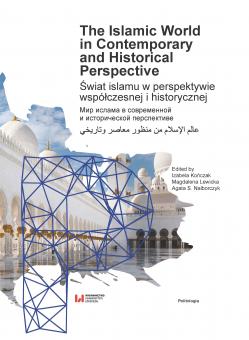
Izabela Kończak (ed.)
University of Łódź, (Faculty of International and Political Studies, Department of Middle East and North Africa
Magdalena Lewicka (ed.)
Nicolaus Copernicus University in Toruń, Faculty of Humanities, Department of Oriental Studies
Agata S. Nalborczyk (ed.)
University of Warsaw, Faculty of Oriental Studies, Department for European Islam Studies
Series:
Politology
ISBN AGENT PR
ISBN-13 (15)
978-83-64462-45-0
ISBN (e-book)
ISBN-13 (15)
978-83-8220-220-5
ISBN
ISBN-13 (15)
978-83-8220-219-9
Keywords:
Islam, High Schools in Saudi Arabia, Muslim Minority, Iran, World Trade Center, terrorism
Published:
9 September 2026 — Updated on 5 November 2020
Categories:
Political science and international relations, Open Access
Downloads
What is and where is the Islamic World in 2019? If we understand the Islamic World as all Muslim-majority countries, according to the Pew Research Center (2015) we would find 50 such countries with a total population of over 1.8 billion. The highest percentage (91%) of the total population in a region considering themselves Muslim, can be found in the Middle East-North Africa (MENA). The starting point of Muslim history would be the prophet Muhammad’s revelation in the 7th century, followed by the Islamic Golden Age (8th–14th centuries), when Muslims were ahead of the rest of the world in the arts, science, philosophy, and technology. This period is still remembered and cherished with pride by both Sunni and Shia Muslims, the two biggest denominations within Islam, which – despite common misconceptions in the West – is not a monolith but splits into different religious schools and branches. The modern era has been marked by the more or less direct colonial domination of European powers which left its legacy in many states belonging now to the Islamic world. Much of today’s turmoil in the MENA region has its roots in the colonial times and the fault lines drawn by the European politicians. However, the blame cannot be wholly assigned to external powers: the list of factors contributing to the Middle East’s present complex and often difficult situation is long and includes many internal issues.
Religion and Politics in Islam
M. Yonous Jami, İsmail Gökdeniz
The Absence of a Debate Strategy for the Reality of the Teaching of Islamic Science in Education High Schools in Saudi Arabia
Wail Ismail, Muhammad Hijab al-Huqbani
The Rise and Decline of the Iranian Hardliners: Why Ahmadinejad’s Group Shifted from Power to Opposition
Giorgia Perletta
Democracy, Secularization, and Parliamentarism in the Muslim East: The History of 100th Anniversary of Reforms
Elnara Garibova
The Unknown Aspect of Israeli-Jordanian Relations from 1948 to 1967
Dorit Gottesfeld, Ronen Yitzhak
The Muslim Minority in the Perspective of Hindu Nationalism
Md Sazedul Islam
Prześladowania w raju. Antymuzułmańskie rozruchy na Sri Lance i ich geneza
Agnieszka Kuczkiewicz-Fraś
Republika islamska jako współczesna forma ustroju na przykładzie Iranu i Afganistanu
Jakub Gustaw Gajda
Rękopisy amharskie w piśmie arabskim (ağäm) jako świadectwo kultury literackiej muzułmanów etiopskich
Marcin Krawczuk
Obraz islamu w słoweńskich dziennikach „Delo” i „Dnevnik” w pierwszym tygodniu po atakach terrorystycznych na World Trade Center i Pentagon na tle historii kontaktów Słoweńców z muzułmanami
Aleksandra Grąbkowska
Ofiary czy terroryści? Wizerunki uchodźców na okładkach polskich prawicowych tygodników opinii
Aleksandra M. Różalska
Czeczenia w polskiej prasie w latach 90. XX wieku. Na przykładzie analizy wybranych opiniotwórczych tygodników
Andrzej Stopczyński
„Swoi” czy „obcy”? Uchodźcy czeczeńscy w Polsce
Katarzyna Wasiak
Европейский ислам Тарика Рамадана: новый европейский мазхаб?
Arzu Sadykhova
Проблемы и технологии взаимодействия государства и институтов ислама: опыт России и Евросоюза
Sergey Chirun
Download data is not yet available.
Copyright (c) 2020 © Copyright by authors, Łódź - Kraków 2020; © Copyright for this edition by University of Łódź, Łódź - Kraków 2020; © Copyright for this edition by Agent PR, Łódź - Kraków 2020
License

This work is licensed under a Creative Commons Attribution-NonCommercial-NoDerivatives 4.0 International License.
How to Cite
Kończak, I., Lewicka, M., & Nalborczyk, A. S. (Eds.). (2020). The Islamic World in Contemporary and Historical Perspective / Świat islamu w perspektywie współczesnej i historycznej. Lodz University Press. https://doi.org/10.18778/8220-219-9
Category
- Archaeology
- Bibliology and information science
- Biology
- Chemistry
- Economics and management
- Ethnology and cultural anthropology
- Polish philology
- Foreign language studies
- Philosophy
- Physics
- Geography
- History
- Linguistics
- Judaica
- Culture and art
- Literary Studies
- Mathematics
- Pedagogy
- Textbooks for foreigners
- Political science and international relations
- Law
- Psychology
- Sociology
- Other
- Open Access
Series
- 100 Years of Independence
- The Academy of Local Governments
- The Academy of Management and Finance
- Handicapable
- Literary and Linguistic Analects
- Balkans XX/XXI
- Bibliotheca Litteraria
- Bibliotheca Philosophica
- Biography and Biography Research
- Byzantina Lodziensia
- Contemporary Asian Studies Series
- Digitisation
- Education for Wisdom
- Economics
- Film! Scholars
- Finance
- Gerontology
- Interdisciplinary Urban Studies
- Literary Interpretations
- Jerzy Giedroyc and...
- Jerzy Giedroyc and Witnesses of History
- Winter of Life?
- Linguistics
- Judaica Lodzensia
- Jurisprudence
- What Is Man?
- Cognitive Science
- Communication and Media
- A Very Short Introduction
- Literary Culture of Lodz
- Literary Studies
- Lodz Studies in English and General Linguistics
- Lodz in the Polish People's Republic. The Polish People's Republic in Lodz
- Manufactura Hispánica Lodziense
- Marketing
- The monographs of the Section of Disability Sociology of the Polish Sociological Association
- The Art of Learning – The Learning of Art
- Neuroscience in Psychology
- Faces of Feminism
- Faces of war
- Biographical Perspectives
- Politology
- Poland and Central and Eastern Europe in the 20th Century
- Polish Film Culture
- Law
- The Polish People's Republic. Biographies
- Existence and Literature Project
- The Psychology of Everything
- Research on Science & Natural Philosophy
- Romanistyka dla Teatru
- Series Ceranea
- The Conference on Social Pedagogy under the Patronage of the Committee on Pedagogical Sciences of the Polish Academy of Sciences
- Art – Media – Culture
- Pedagogical Therapy
- Creativity and Education
- Vade Nobiscum
- Warsztaty z Geografii Turyzmu
- Early Education
- In Search for the 21st Century Ideas
- The Tower of Babel – in Polish
- Management
- Private Life of Poles in the 19th Century